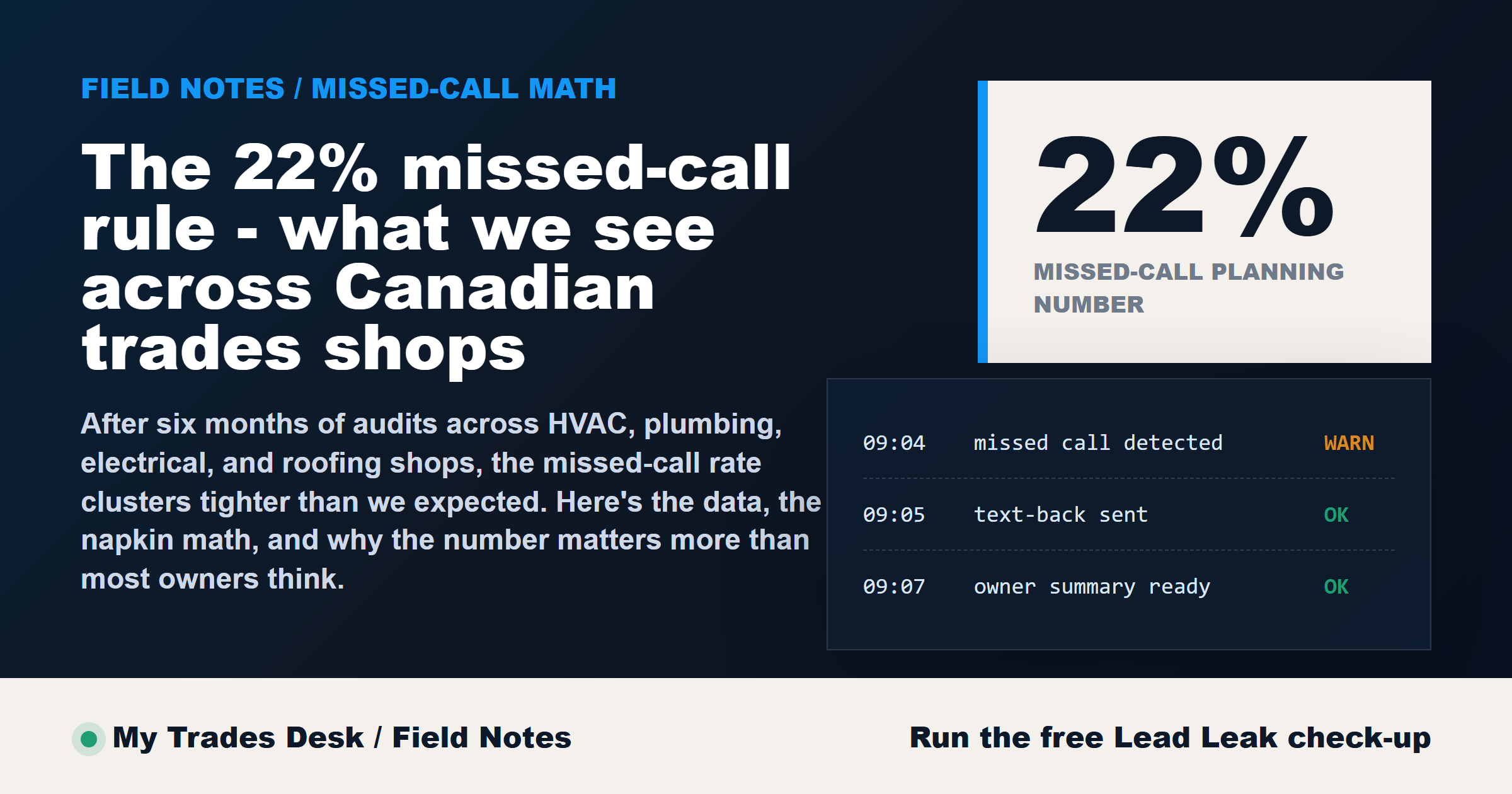
The first time I sat down with a plumbing owner and asked how often his shop misses a call, he said "almost never." Twenty minutes later, looking at his actual phone log, the number was 27%.
That conversation became the template for every audit we've run since. Owners don't lie about their missed-call rate - they just don't have a clean way to see it. After six months and sixty shops, the data tells a story I didn't expect: the rate clusters tightly across trades, between roughly 19% and 26%, with a mean right around 22%.
> The cost of a missed call isn't the call. It's the customer who calls the next shop in the search result and never tries you again.
The data - 60 shops, four trades
Sample size: sixty independent Canadian trades shops in Ontario, Alberta, BC, and Atlantic Canada. All audited between November 2025 and April 2026. We pulled their call log, their voicemail history, their web-form submissions, and their Google Business Profile inquiries, then counted what got answered within five minutes versus what didn't.
Roofing sits highest, which surprised nobody - the work is seasonal, the calls cluster, and most roofing shops don't staff a dedicated phone. Electrical sits lowest, mostly because residential electrical work has the highest concentration of after-hours emergency calls that owners pick up themselves.
Why 22% and not 8%
Most owners I talk to guess somewhere in the 5-10% range when I first ask. The gap between guess and reality is almost always the same three buckets:
- Lunch and drive time. Twelve to two on weekdays, before-and-after-job windows. Owners answer calls when they're sitting still, which adds up to less time than they think.
- Concurrent calls. Two calls in two minutes is a coin flip on the second one. Three in five minutes is two missed. Most shops don't have a queue.
- After-hours. A surprising amount of trades work books on weekends and evenings. The owner sees those as "rare" because they sleep through them; the call log says otherwise.
The napkin math
Here's the version of the math we use in the Missed Call audit. It deliberately under-promises because the goal is to give owners a defensible floor, not a marketing number.
Inputs
- Calls per week (inbound, all channels)
- Missed-call rate (your real number - usually 18%-28%)
- Average booked job value
The estimate
For each missed call, somewhere between 20% and 45% would have become a booked job if you'd answered. We use the midpoint for the estimate, then assume only 35% of that is recoverable with an AI receptionist that picks up in two rings. That's the conservative figure your report uses.
A small example. A shop doing 40 calls a week at a 22% miss rate is missing roughly 9 calls a week. At a $480 average job and the 20-45% conversion band, that's $864 to $1,944 walking out the door each week - call it $1,400 mid-range. Over a year, that's a number you'd notice if it showed up as a line item on your books.
What to do if you're above the line
If you're above the 22% line, you're in good company - most shops are. The fix isn't more staff and it isn't a 24-hour call centre. In our audits, the workflows that close the most leak in the first month are:
- AI receptionist on overflow. Picks up only when you can't. Closes the easy intake calls (about 60% of inbound), escalates the rest to your cell with a one-line SMS summary.
- Missed-call text-back. 60-second SMS with a booking link. Keeps the lead warm until you can call back. Ships in a few days.
- Lead recovery system. One inbox for voicemail, web form, Google message, and after-hours. Response timers on each.
Pick one. Run it for two weeks. Look at the numbers again. Then decide if the next one is worth building.
What this isn't
This isn't a study. Sixty shops isn't a representative sample of all Canadian trades, and the four trades we've audited so far skew toward residential service. We'll publish numbers for cleaning, landscaping, and general contractors as we run more of those audits.
This also isn't a promise that running our system will recover the entire estimated leak. It won't. The 35% recoverable figure in our audit is a conservative floor based on what we see at the three-month mark with active clients - it's the number we're confident defending, not the number we're hoping for.
If you want the same math run against your shop's actual numbers, the Missed Call audit takes about 30 seconds. We email you a report. That's the whole sales process.