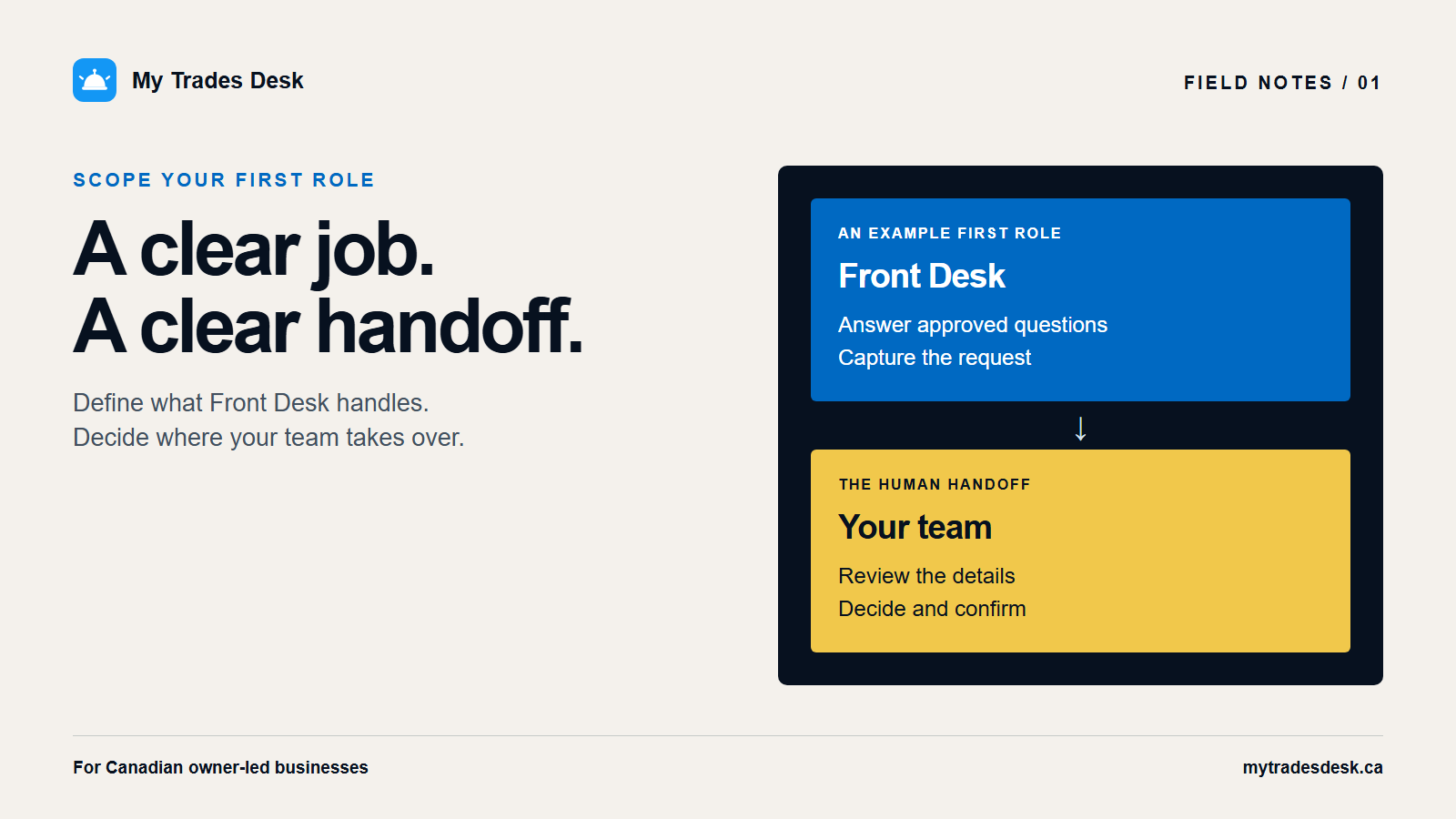
If you run an owner-led business, you may be the person who serves customers, answers the phone, and sorts out the exceptions. A useful first AI Front Desk role should take a defined part of that work off your hands. You should still know what it can say and when it must ask for help.
At My Trades Desk, we start with the call you want handled, then agree on the scope. The guide below is a way to prepare that conversation. The repair business example is fictional; it is not a customer result or a promise about a ready-made setup.
Choose one kind of call
Start with a repeatable request that has a clear next step. For example, a caller wants to ask about opening hours or leave a request for a repair. Those are different jobs from negotiating a price or resolving a complaint.
Write a short role statement:
Example role: When our team cannot answer, Front Desk should collect routine repair requests so the owner can decide what to accept and call the customer back.
That statement gives you something to test. It also leaves room for your business rules. A retailer, a service business, and an appointment-based business will need different questions. They do not need to start with every type of call.
If you are unsure where to begin, look at the calls your team already handles. Choose a common request with answers you can approve in advance. Leave requests that need judgment for a person.
Give Front Desk a small set of approved jobs
For a first role, consider these jobs:
- Answer basic questions from information you have checked, such as hours or service area.
- Ask for the caller's name, callback number, and a short reason for calling.
- Ask the few extra questions your team needs to decide the next step.
- Repeat the request back so the caller can correct it.
- Explain what happens next using wording you have approved.
Keep the information current. If your hours change, someone must update the approved answer. If a service is outside your area, the answer should say that clearly.
Booking needs its own rules. Taking a preferred time is not the same as confirming an appointment. Only include confirmed booking after the calendar, availability rules, and failure behaviour have been checked and tested for your setup.
Write down where a person takes over
An instruction such as “use your judgment” leaves too much open. Write the boundary in terms a caller would recognise.
For the fictional repair business, Front Desk could collect the item type and the reported problem. It would leave diagnosis, final pricing, warranty decisions, and promises about completion dates with the owner.
Other boundaries might include a caller who disputes a charge, asks for an exception, or wants a service that is not on the approved list. In these cases, the useful action is to explain the limit and pass on the request.
Decide what “pass on” means. A callback request and a live transfer are different. Do not promise that someone will answer now unless that route is available and tested. Front Desk is not an emergency service; any urgent-call wording needs a separate, approved rule.
Make the handoff useful
A summary should help a person act without making the caller repeat the whole conversation. Include only the details that the team needs for the agreed job.
For this fictional example, a useful summary would say:
Example handoff: Caller: Sam. Callback number: captured and repeated back. Request: a repair assessment for a lawn mower that will not start. Preferred callback: tomorrow morning. Pricing: not quoted. Appointment: not confirmed. Next action: owner to review the request and call back.
The distinction between what the caller asked for and what the business promised matters. Keep both visible.
Agree where the summary goes and who checks it. Also agree what happens if it cannot be delivered or the recipient is away. A captured request still needs an owner.
Test the limits before you expand
Use fictional details in test calls. Include a routine request, an unclear request, a caller who changes their answer, and a request Front Desk must leave to a person.
Check the actual answers and the summary that arrives. Did it capture the right details? Did it avoid promises outside its role? Does the recipient know what to do next?
Start with those answers before adding more duties. You can use our after-hours pilot guide to turn the role into a small, supervised trial.
When you are ready, plan your Front Desk. Tell us which calls interrupt your day and who should receive the handoff. We will discuss the role, required tools, limits, and pilot scope before any paid work starts.