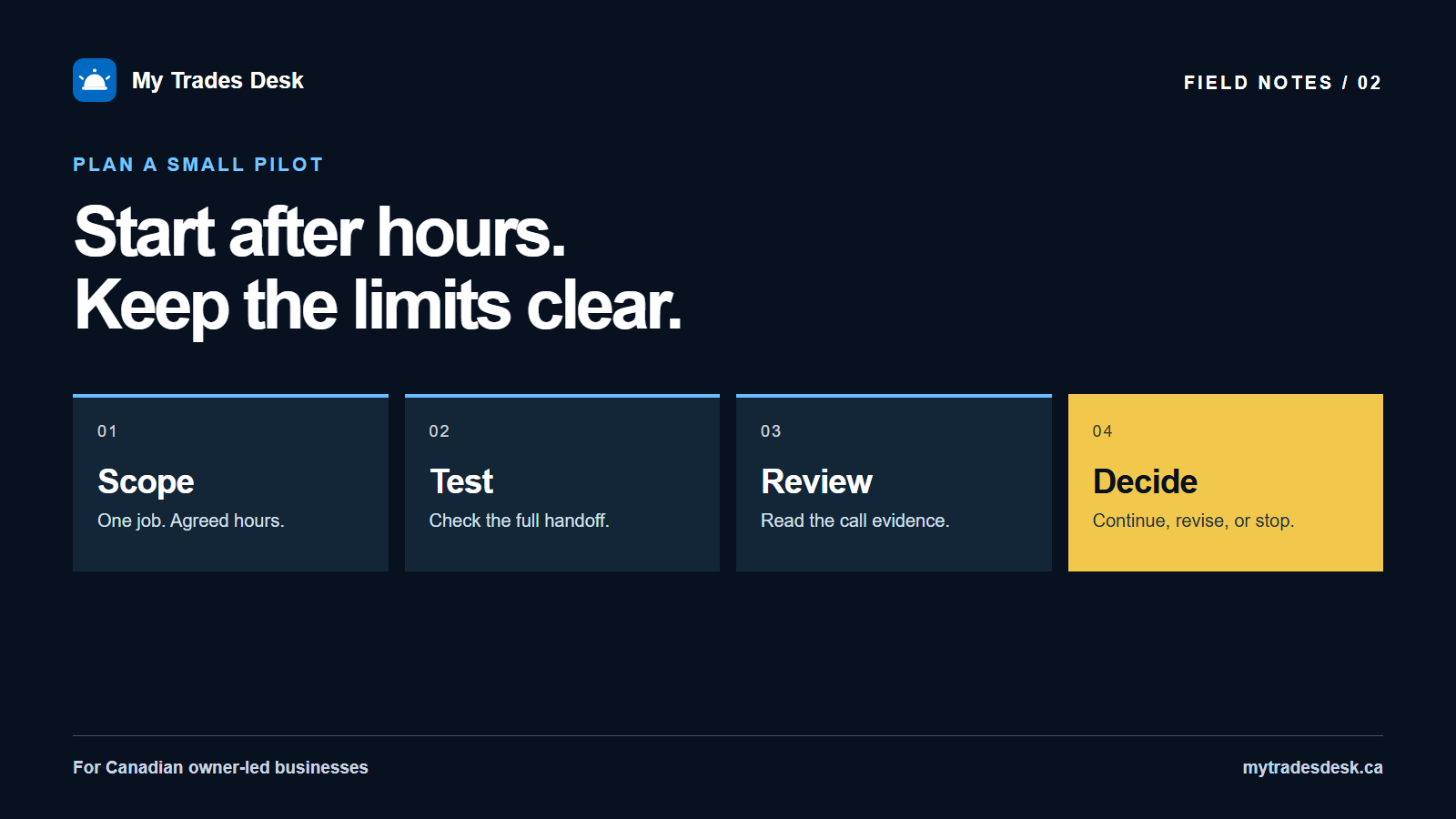
An after-hours pilot can give a Canadian owner-led business a defined place to start with AI call handling. The aim is to learn whether one Front Desk role handles a real need and gives your team useful information. Answering a call is only part of that job.
Treat the pilot as a supervised trial with agreed limits. The service business below is a fictional planning example. It does not describe a customer deployment, a guaranteed result, or a standard package.
Set the coverage window and the job
Choose when the pilot should answer and what it should handle. Be specific about your time zone, closed days, and any holiday exceptions. Keep your existing daytime arrangements clear.
For example, an owner might want routine service requests collected after closing. Front Desk could ask what the caller needs, capture a callback number, and explain that a person will review the request when the business reopens.
That role does not include dispatching someone immediately or confirming a job. If either action is needed, it requires its own approved rules and a tested route to the person or tool that can complete it.
Write the scope in plain language:
Example scope: During our agreed closed hours, collect routine service requests for review when we reopen. Do not quote a final price or promise an arrival time.
Also decide how to handle calls outside that scope. Our guide to your first Front Desk role can help you draw those limits.
Name the owner and the fallback
Give one person responsibility for reviewing pilot calls and following up. Agree where requests should arrive and when that person will check them. If a second person provides cover, make that responsibility clear too.
Then decide what happens when the normal route fails. For example, the intended fallback might be your existing voicemail or answering service. The right choice depends on your phone setup and who is available. Test it before real callers depend on it.
Prepare a short operating note with:
- The coverage window and the approved opening message.
- The questions Front Desk may ask and the answers it may give.
- The person who receives requests and the expected follow-up action.
- The route to use if Front Desk or delivery is unavailable.
- The person who can pause the pilot and restore the fallback.
Settle how callers will be told they are speaking with AI. Agree what information the pilot needs, who can access it, and how it will be removed when no longer needed. If calls will be recorded, settle the notice and recording settings before launch. These are setup decisions to review, not a reason to collect extra details.
Test the awkward calls too
Use fictional names and contact details during setup tests. Check the full path from the call to the message the recipient receives.
A useful test set includes:
- A routine request with clear answers.
- A caller who corrects their callback number.
- A question about a price that has not been approved.
- A request for a confirmed appointment when booking is outside the role.
- A caller who asks for immediate help.
- An unclear request that Front Desk cannot resolve.
- A failed delivery or unavailable recipient.
For each test, write down what should happen before making the call. Then compare the answer and handoff with that expectation. A polite response can still be wrong if it invents availability or sends an incomplete summary.
Keep setup tests separate from the live pilot review. Passing rehearsed calls tells you the setup is ready for a controlled trial. It does not prove how it will perform with every caller.
Agree on the review criteria
Decide what you will inspect, who will inspect it, and when the pilot ends. Include the pilot cost and any usage limits in the agreement before paid work begins.
Useful review questions are concrete. Were the required details captured correctly? Did Front Desk stay within the approved answers? Did the request reach the right person? Could that person take the next step? Did any caller receive a promise the business could not keep?
Track errors and the time your team spends correcting them. If you also count calls or later bookings, keep those records separate. An answered call is not automatically a qualified request, a booking, or revenue.
Agree in advance which failures require an immediate pause. An unsupported urgent-response promise or repeated failure to deliver requests should not wait for the scheduled review.
Make a clear decision at the end
At the review, choose a next step: continue the same role, revise and retest it, expand a specific duty, or return to the fallback. Use the call evidence and the team's experience to make that choice.
If few relevant calls came in, say so. A quiet pilot gives limited evidence. You can agree to a longer trial without presenting the early result as proof of success.
To prepare a scope with us, plan your Front Desk. Bring your current after-hours process, the calls you want covered, and the person who will own the follow-up. We will discuss the fit, tools, limits, price, and review criteria before the pilot starts.